
Introducing the new bunny.net developer documentation

Jamie Barton

January 27, 2026
Great developer experiences start with great documentation. That's why we just launched new bunny.net developer docs, rebuilt from the ground up to better support how developers actually build, explore, and integrate with bunny.net.
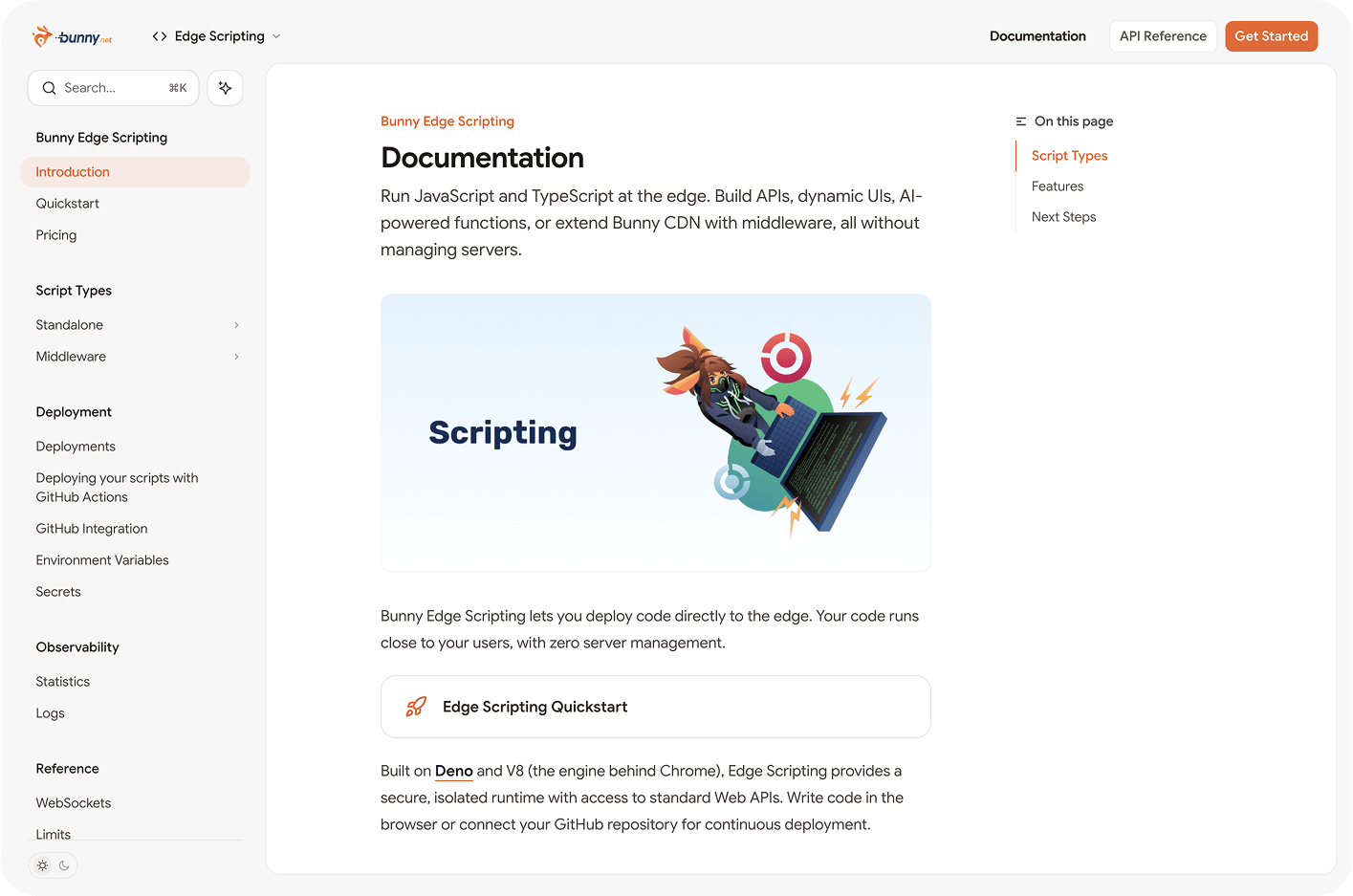
Our previous documentation lived on an outdated platform that didn't scale with bunny.net's growth, nor with the expectations developers now have for modern dev tools.
As our product offering grew, the docs became increasingly flat and unstructured. Everything lived at the same level, which made it hard for people to stay focused and find the right docs quickly.
Listening to your feedback, one theme kept coming up: the experience felt overwhelming. Finding the right information often meant losing context, jumping between pages, or second-guessing whether you were even in the right place.
At the same time, the bar for developer documentation has risen. Devs expect modern, clean, and structured docs, AI-friendly content structures, copyable pages for LLMs and tools, and interactive API references with code snippets.
So we decided it was time for a complete rethink.
The solution: documentation built around products
The biggest change is structure. Instead of a single, flat documentation space, each bunny.net product now has its own dedicated area. This allows developers to fully immerse themselves in one product at a time, without distractions.
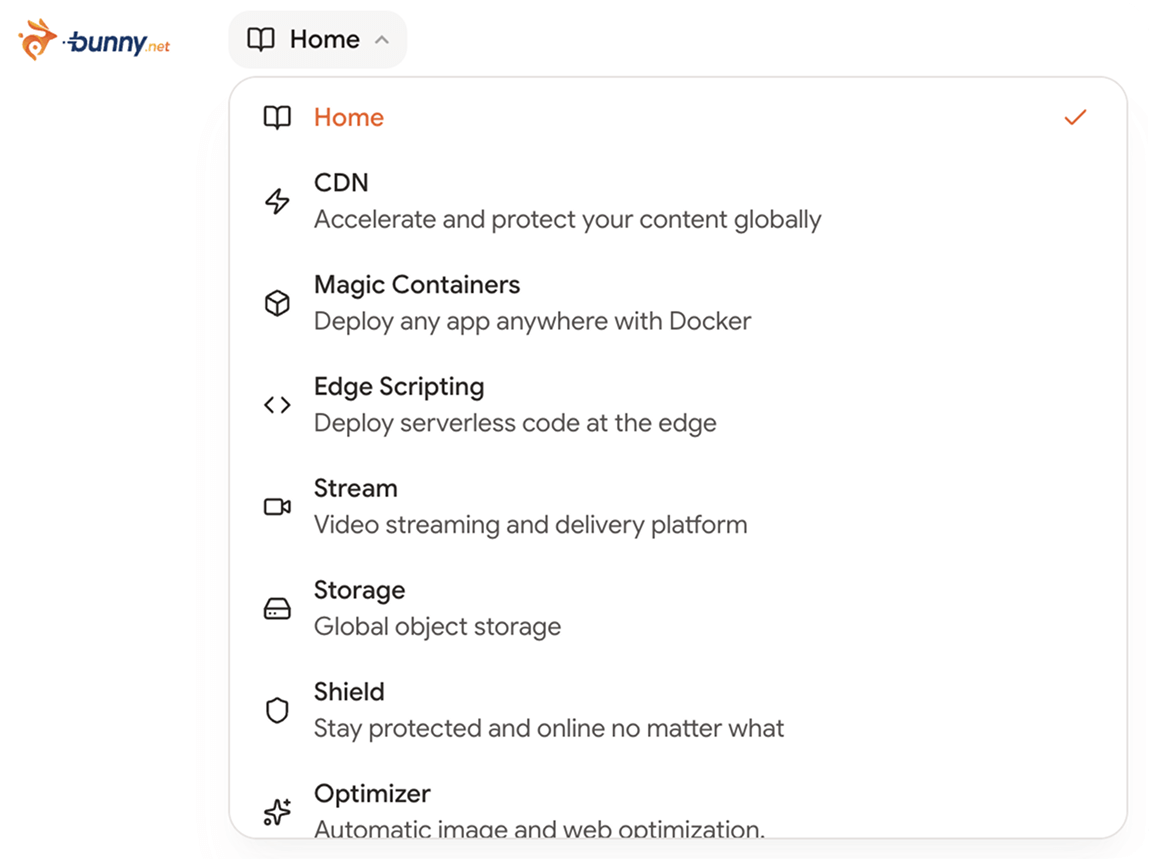
The new documentation contains spaces for each product:
- Magic Containers: Docker-based container deployment close to users
- Edge Scripting: Serverless functions with TypeScript
- Database: Serverless SQLite over HTTP
- CDN: Content delivery, acceleration, and edge rules
- Shield: WAF, DDoS protection, rate limiting, and bot detection
- Stream: Video streaming, encoding, and DRM
- Storage: Global object storage
- Optimizer: Automatic image and web optimization
- DNS: Ultra-fast, scriptable DNS with DNSSEC
Within each product, you'll find clearly organized sections: Quickstarts to get up and running fast, Feature documentation that goes deep when you need it, Practical examples to see real-world usage, and Guides that stay relevant to the product you're working on.
The goal is simple: when you're working with a bunny.net product, everything you need should be right there, in context.
A complete API overhaul
We've significantly upgraded our API reference across all products. Our API documentation is now fully OpenAPI-spec-driven, which unlocks a much richer experience:
- Make real API requests directly from the browser
- Explore accurate request and response examples
- See up-to-date schemas generated from the source of truth
- Understand endpoints faster with consistent, structured layouts
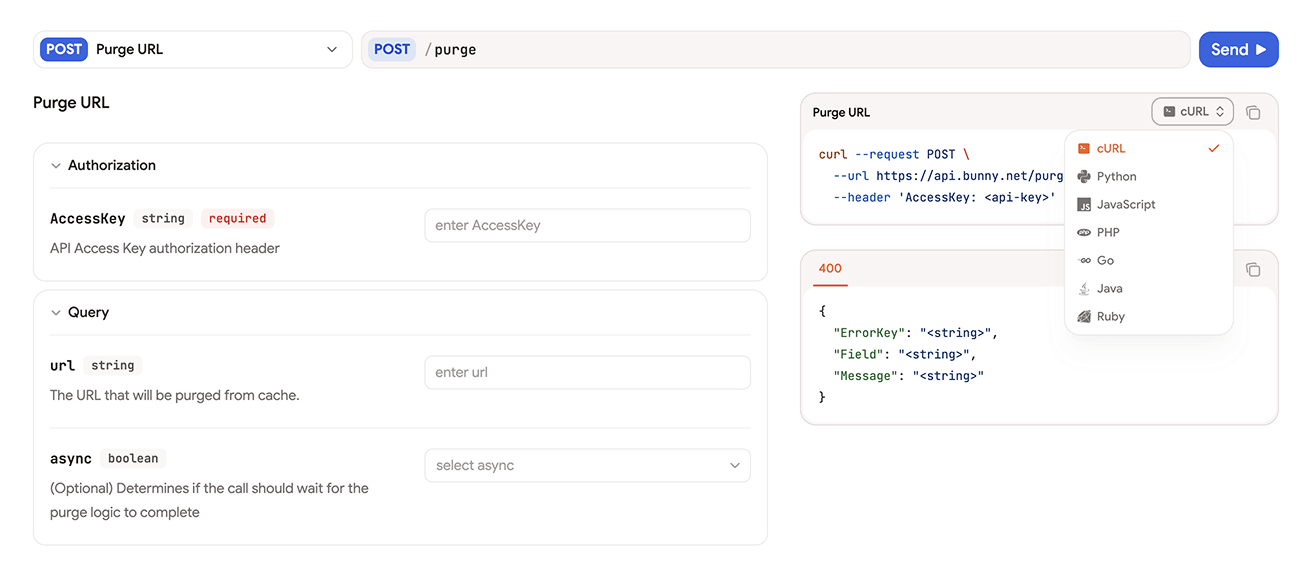
Whether you're exploring an API for the first time or debugging an integration, the new API Reference is designed to be both powerful and approachable.
SDKs, examples, and integrations
We've added SDK documentation for Storage across multiple languages: TypeScript, PHP, .NET, and Java. Each SDK comes with installation instructions, authentication setup, and practical examples for common operations.
Documentation isn't just about explaining features. It's about showing how to use them. Each product includes practical, copy-paste-ready examples. Edge Scripting, for instance, comes with examples for common patterns like modifying response headers, handling redirects, and returning structured JSON and connecting to a database, all in TypeScript.
We've also started to migrate some useful integration guides from our support knowledge base, covering popular platforms like WordPress, Shopware, Drupal, and Magento on the CMS side, plus cloud storage providers like Amazon S3, Azure Blob, Backblaze, and DigitalOcean Spaces.
What's next: hopping forward
This new documentation platform gives us the flexibility to keep improving: adding more guides, tutorials, embedding videos, embracing AI-assisted workflows, and evolving alongside the wider developer ecosystem.
The new documentation includes nearly 300 new pages of content organized across quickstarts, feature guides, API references, SDK documentation, and real-world examples. And we're just getting started.
Most importantly, it gives us a solid foundation to continue listening to your feedback and iterating quickly.
Explore the new docs
We're excited to share this with the community and would love to hear what you think. Dive in, explore your favorite bunny.net products, and let us know how the new experience works for you.