



It's just a video. How hard can it be?

Nathan Zerafa

November 2, 2026
What 509 teams told us about running video, and what to do about it.
Written for product and engineering teams building or managing video-powered platforms, including OTT and streaming services, EdTech, UGC apps, and white-label video solutions.
We surveyed 509 teams using Bunny Stream to understand the biggest challenges of running video in 2026, including infrastructure complexity, rising costs, AI adoption, and newer video codecs.
Here are four key takeaways and what they could mean for your video platform.
TL;DR
- 77% want less complexity. Teams use managed platforms to avoid handling encoding and delivery themselves. Consider: Where could you reduce operational overhead?
- 63% struggle to predict bandwidth costs; 50% say the same about storage. Both become harder to manage as video usage grows. Consider: How will growth affect your costs?
- 59% aren't using AI in production. Those who do focus on practical applications like transcription and translation. Consider: Where could AI deliver real value?
- 14% use AV1; 38% are interested in newer codecs but have no adoption plan. Bandwidth savings need to justify the implementation effort. Consider: Would newer codecs benefit your platform?
For viewers, video is simple. Press play, watch, move on.
Behind that play button, there's encoding, storage, delivery, playback compatibility, and an infrastructure bill that can grow unexpectedly.
Whether you're running an OTT service, an online learning platform, or a video-driven app, managing those moving parts becomes more challenging as your audience and content library grow.
Our Running video in 2026 report examines how teams handle these challenges. Let's look at what the findings mean for your video operations.
1. Complexity is the real cost
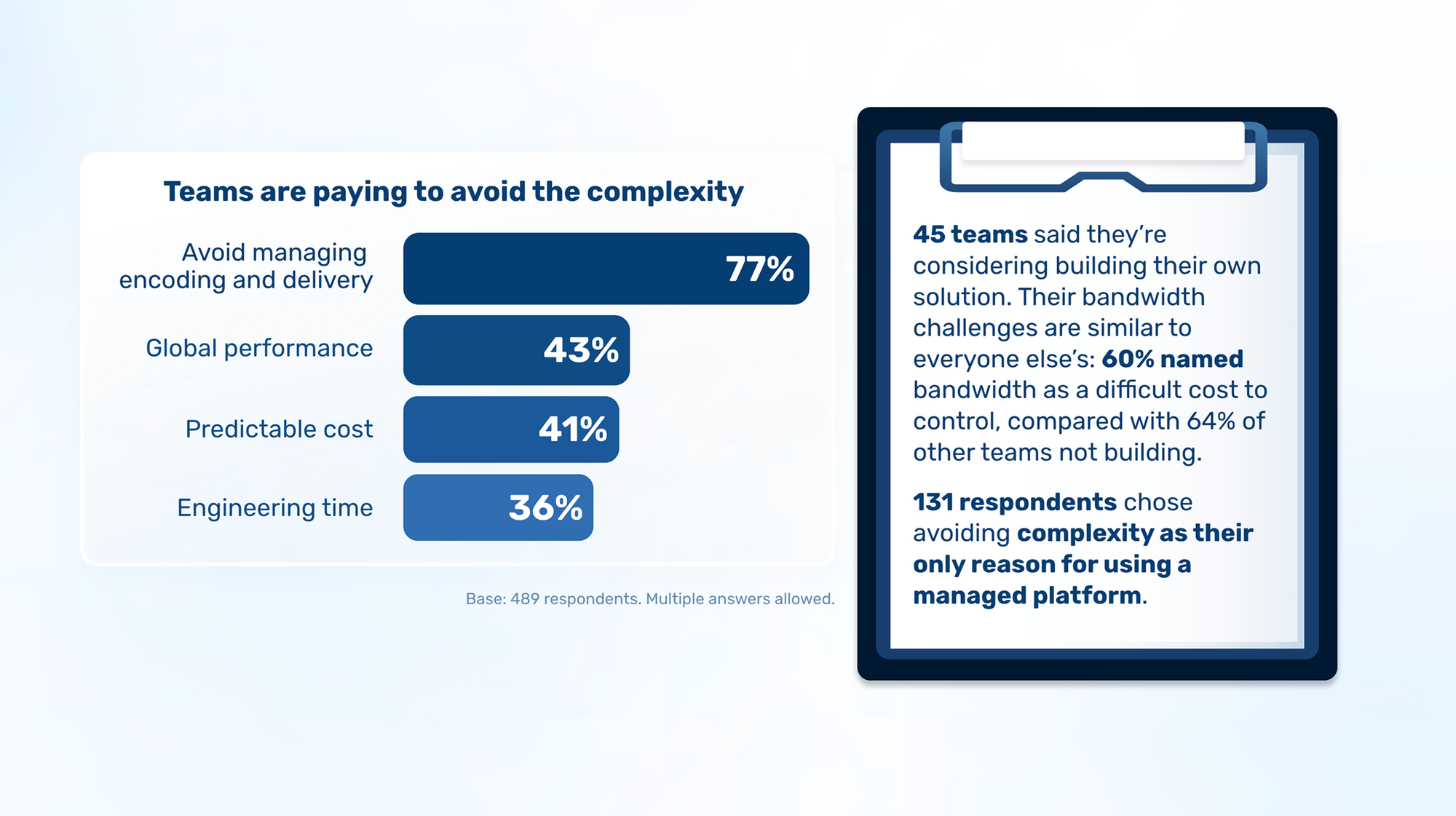
77% of respondents use a managed video platform to avoid handling encoding and delivery themselves.
Only 41% selected predictable costs as a reason, and just 10% selected cost without also selecting complexity.
Why complexity matters
Running video involves more than hosting files and making them available to viewers.
There's the technical side: encoding, storage, adaptive bitrate streaming, and delivering content across different regions. Then there's playback. Videos need to work across browsers, smartphones, connected TVs, and varying network conditions. And finally, there's the operational work: managing providers, integrations, invoices, usage limits, and troubleshooting. The challenges vary depending on your platform.
- An OTT streaming provider might need to handle sudden audience spikes during live events while maintaining consistent playback across devices.
- A social media or UGC platform might deal with unpredictable upload volumes and multiple video formats.
- Meanwhile, white-label video providers need infrastructure that supports several customers, each with different requirements.
One Bunny Stream customer shared that they previously relied on 10 to 12 separate services to support their video workflows, including playback across multiple devices.
Each additional service can introduce another integration, billing cycle, or potential point of failure.
What this means for your team
Managing several services isn't necessarily a problem, especially when each serves a specific purpose. But as your platform grows, it's worth evaluating how much engineering time goes into maintaining your existing video infrastructure.
Could consolidating certain services reduce the work your team handles? Are there workflows that a managed platform could handle?
The findings suggest that teams value the operational work a platform removes, not just the technology it provides.
When evaluating video infrastructure, consider the resources required to manage it, as well as performance, features, and price.
2. Bandwidth and storage: The costs you can't predict
Two costs stood out in our survey:
- 63% identified CDN bandwidth as one of their hardest costs to control or predict.
- 50% said the same about video storage.
A quarter of respondents selected both.
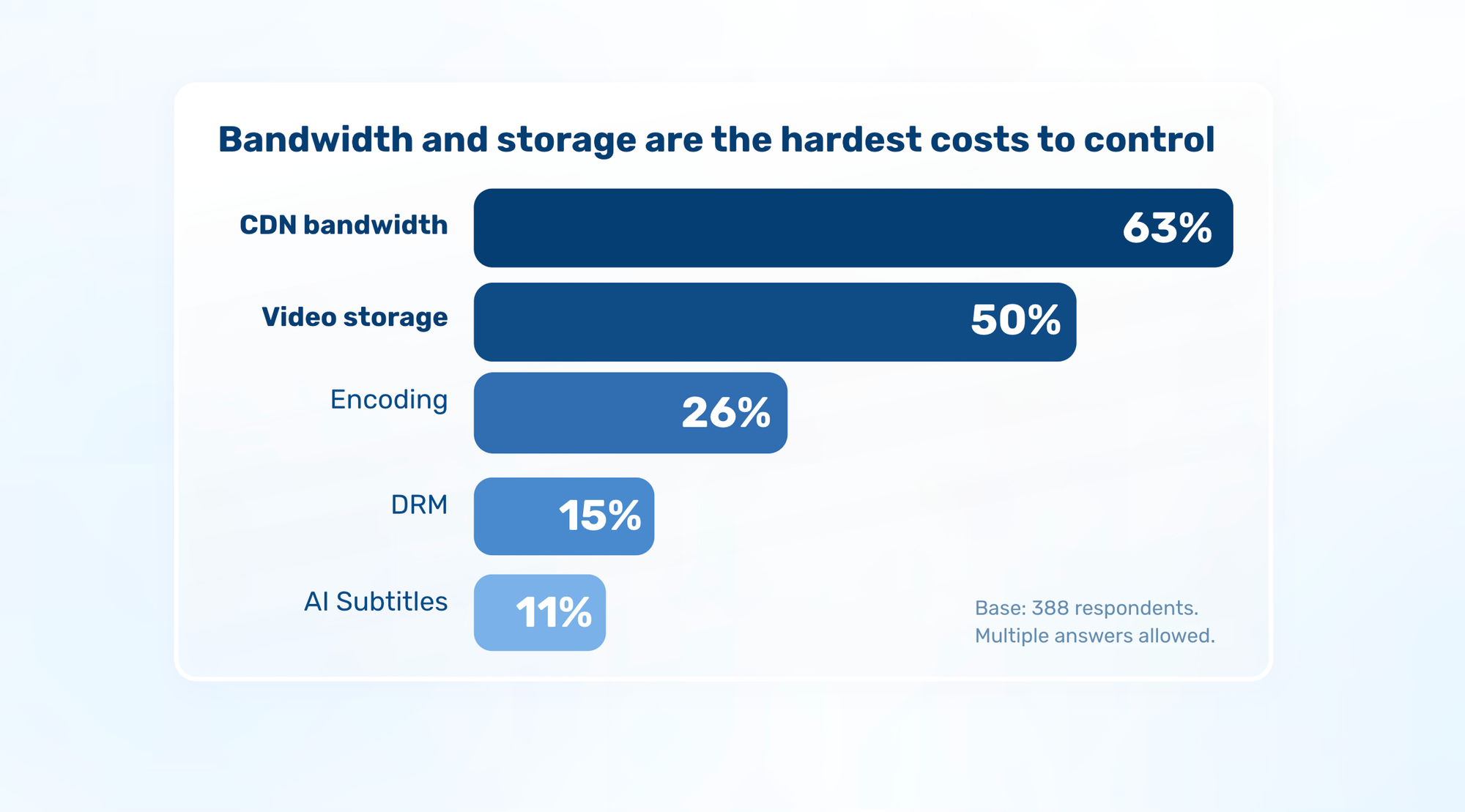
We asked which costs were hardest to control, rather than which represented the largest share of spending.
Why these costs are difficult to control
Bandwidth and storage respond to different aspects of video usage.
Bandwidth depends heavily on how much content viewers consume. An increase in viewing time, audience size, or delivered bitrate can increase the amount of data transferred.
- For an OTT service, a popular release or live event could generate a sudden increase in traffic.
- A mobile-first video platform might see a particular series gain popularity and drive significantly more viewing than expected.
Storage presents a different challenge.
An EdTech provider might retain courses for years, while a UGC platform might receive thousands of new uploads without knowing which ones will attract viewers.
For platforms with growing libraries, storage requirements can accumulate even when viewership stays relatively stable.
Storage can become an operational challenge as well as a financial one.
What this means for your team
Understanding your usage patterns can help you anticipate how costs might change.
A relatively small library with high viewership can generate substantial bandwidth usage. A large archive of rarely watched content may have a very different cost profile.
Consider how your video usage might evolve as your audience grows, your catalog expands, or you enter new markets.
When comparing providers, it's also worth understanding what you're paying for and how pricing changes with usage.
Features such as encoding, content protection, and captions may introduce additional costs depending on the platform.
The goal is to understand how your infrastructure costs could change as your business grows, rather than evaluating providers based solely on today's usage.
3. AI adoption lags behind the hype
AI has become a major topic across the video industry, with applications spanning content creation, localization, accessibility, and video processing.
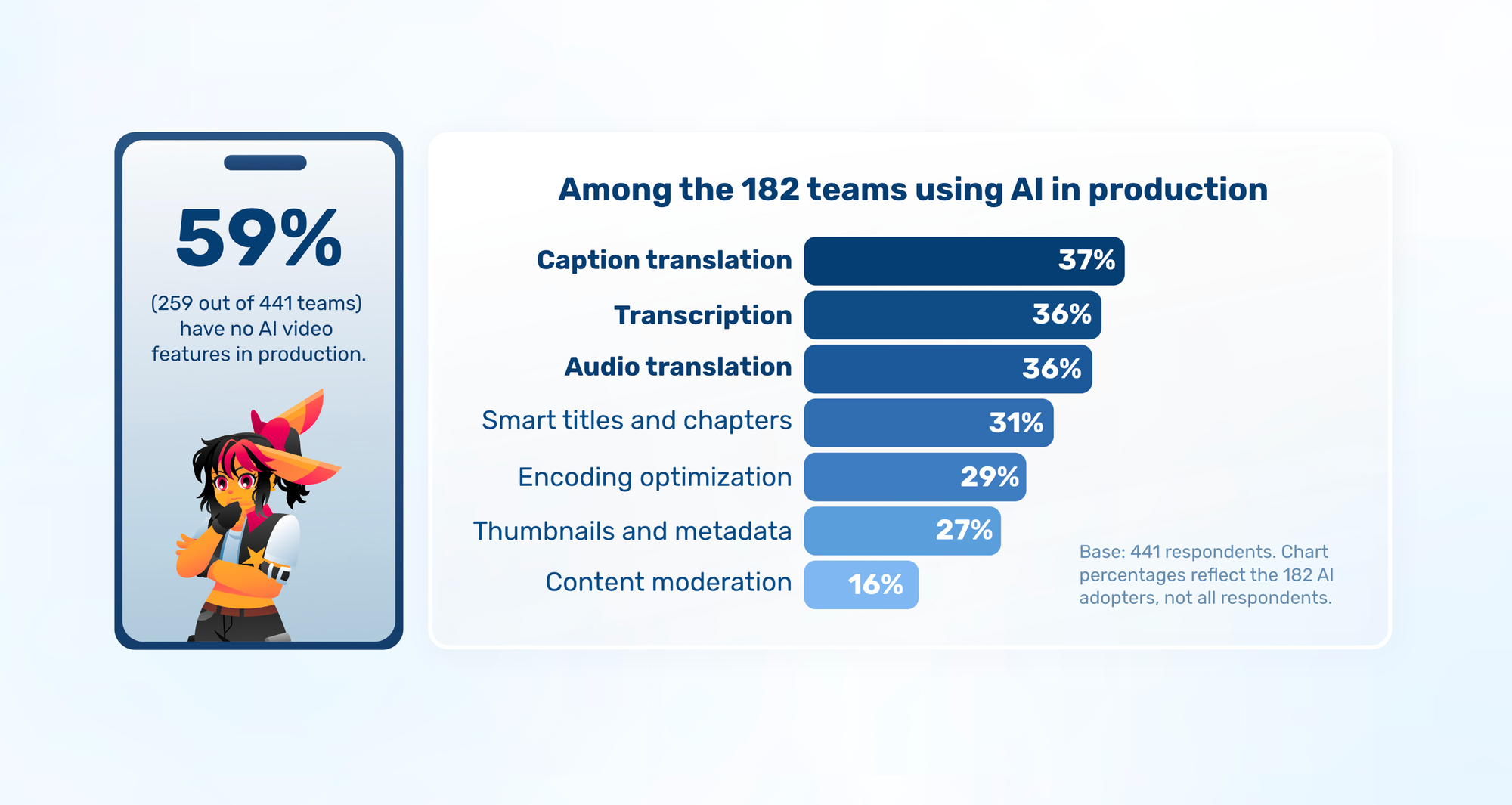
But our survey found that 59% of respondents have no AI video features running in production.
Among those who do use AI, transcription, caption translation, and audio translation are the most popular features.
Teams using AI have an average of 2.4 features in production.
What teams are using AI for
Many of the most widely adopted AI features address existing operational needs.
- Transcription can generate text versions of video content, while translation helps make content available to audiences in additional languages.
- Encoding optimization can also help improve delivery efficiency.
- For an educational platform, automated transcription could support accessibility and make learning materials easier to navigate.
- An OTT provider expanding internationally might benefit more from translation, while a UGC platform could find opportunities in content moderation or metadata generation.
The value depends on what the platform needs.
One customer shared that they only use AI transcription when content arrives without subtitles. If the supplier already provides them, there's no need to generate them again.
What this means for your team
Nearly 40% of respondents who use AI in production have implemented only one feature.
For teams exploring AI, a focused approach may be more useful than introducing several features at once.
Consider which activities require the most manual work or where automation could improve the experience for viewers.
That could mean accessibility, localization, encoding optimization, or content management.
Evaluate AI based on the problems it can solve for your platform, rather than the number of features available.
4. Newer codecs: High interest, limited adoption
Video codecs determine how video is compressed, affecting the amount of data required to store and deliver content at a given quality.
H.264 remains widely supported across devices and browsers. Newer codecs, such as HEVC (H.265) and AV1, can offer better compression efficiency, potentially reducing bandwidth consumption while maintaining comparable visual quality.
Given how many teams find with bandwidth costs difficult to predict or control, newer codecs offer an opportunity to improve delivery efficiency.
But adoption remains limited.
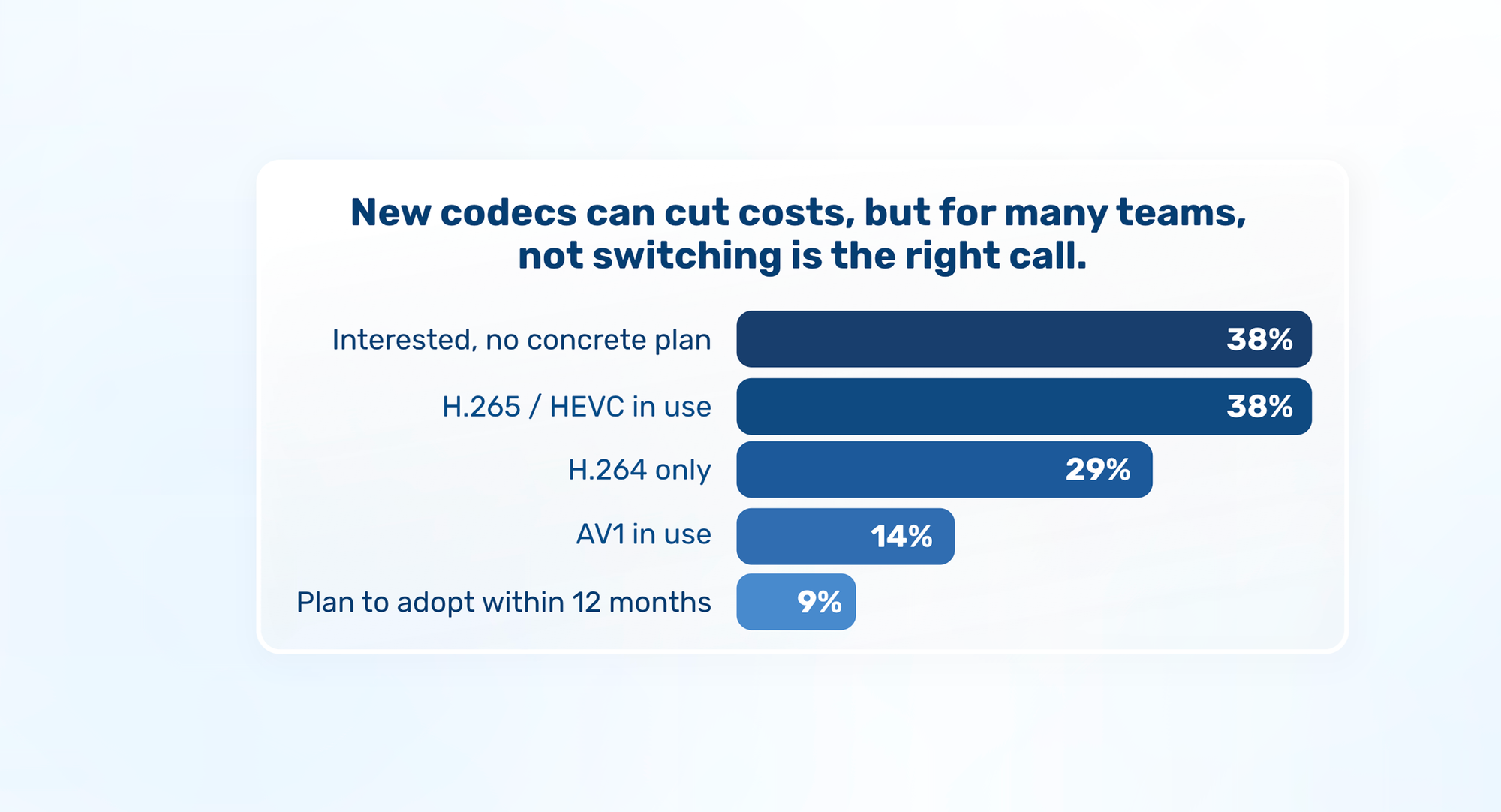
Only 14% of respondents currently use AV1.
While 38% are interested in newer codecs, they have no concrete adoption plans. Just 9% plan to adopt one within the next 12 months.
Meanwhile, 29% continue to use H.264 exclusively.
Why teams are taking their time
Better compression can reduce delivery costs, but adopting a new codec introduces additional work. Teams may need to re-encode existing content, support multiple formats, and test playback compatibility across devices. Depending on their setup, they might also need to store multiple versions of the same video.
The potential savings also vary across platforms.
- A service with a large library of frequently watched videos could benefit considerably from more efficient compression over time.
- A platform publishing short-lived content might have different priorities.
Device compatibility matters too. A service targeting connected TVs, for example, may face different playback requirements than a mobile-first video platform.
Interestingly, 73% of respondents using newer codecs identified bandwidth as a difficult cost to control, compared with 65% of respondents using only H.264.
This doesn't tell us why teams adopted newer codecs, but it shows that bandwidth remains a concern even among those already using them.
What this means for your team
Newer codecs offer opportunities to optimize video delivery, but the benefits need to justify the implementation effort.
Consider your audience's devices, viewing habits, content library, and bandwidth requirements.
For platforms with high delivery volumes, better compression could create meaningful long-term savings. For others, playback compatibility and operational requirements may take priority.
Your codec strategy should reflect how your audience consumes video and what your platform needs to support.
How Bunny Stream approaches these challenges
At bunny.net, we've built Bunny Stream to help teams manage the infrastructure behind video without having to maintain every component separately.
Bunny Stream brings encoding, storage, delivery, and playback together in one platform, powered by bunny.net's own storage and global CDN infrastructure.
Whether you're operating an educational platform, building a streaming service, or integrating video into another product, Bunny Stream helps reduce the operational work involved in delivering video.
Simplifying infrastructure doesn't eliminate the need to plan for bandwidth, storage, or future requirements, but it can reduce the number of systems your team needs to maintain.
There's more behind the play button
Our survey highlights several challenges shared by video teams across different industries and business models.
For some, the priority is simplifying infrastructure. For others, it's understanding how costs will change with growth or deciding which new technologies are worth adopting.
The right approach depends on how your platform operates, what your audience needs, and where you expect your business to grow.
Want to see how your challenges compare with those of other video teams?
Explore the complete findings, charts, and recommendations in our Running video in 2026 report.
And if you're exploring ways to simplify your video infrastructure, take a look at Bunny Stream.
About the research: bunny.net surveyed 509 teams through an in-product questionnaire in September 2026. Respondents already used managed video infrastructure, and 291 completed all four questions. Results represent the respondents to each question, and participants could select multiple answers. The survey did not collect industry, company size, or regional breakdowns. Industry examples in this article illustrate how the findings may apply to different types of video businesses rather than representing industry-specific survey results.
Comments require cookies. to view and post.