



Dino Kukić joins bunny.net as Developer Growth Marketing Lead
Michelle Runyon

May 5, 2026
Dino doesn’t buy into the idea that developers are an impossible audience to market to.
He’s spent enough time working closely with both the product and the people using it to question many of the assumptions that tend to come with that label. He does marketing, builds things on the side, and always has.
So when it comes to product adoption, Dino has a clear take on what makes marketing a product successful. Now, as Developer Growth Marketing Lead at bunny.net, he’s helping us hone in on that.
Let’s hop into the details. Here’s his story.
So, where are you from and where are you based now?
I’m from Serbia and currently based in Prague, Czech Republic, but I’ve moved around quite a bit. I studied in Denmark, then moved to Munich for an internship, spent some time in Hong Kong, and later moved to Liechtenstein for my master’s before settling in the Czech Republic. These days, I also spend a lot of time in Poland.
What did your early career look like, and how did you end up working across both marketing and the technical side of things?
It’s hard to pinpoint a single starting point, but I got into marketing and growth through SEO. I started at a company called InterNations in Munich about 11 years ago, and since then I’ve mostly worked with SaaS or SaaS-related companies.
At the same time, I was studying marketing for my bachelor’s degree and started building websites early on, first with HTML and CSS, then picking up the basics of JavaScript and PHP. That’s where I found the overlap between the two. SEO felt like a natural bridge, so I went deeper into it and landed an internship.
I ended up staying in marketing, but I kept building alongside it. In one of my early roles, I started learning Python and built small tools and automation scripts to make my work easier. I also freelanced for a while, building landing pages for marketing teams, although that never turned into a full-time gig.
A few years ago, I even considered switching fully into a technical role and went on to do a master’s in Information Systems. In the end, I stayed in marketing, but that technical background helps a lot in what I do now.
Dino's take on marketing and developers

What does developer growth marketing mean to you, and how do you approach marketing to developers without it feeling like a sales pitch?
In many ways, it doesn’t differ that much. Marketing is still marketing, and “knowing your market” applies across the board. The difference is that developer tools can get quite technical, so as marketers, we need to get hands-on to really understand the domain.
I don’t think anyone likes being marketed to. People are simply more or less receptive depending on the situation. When you move to a new city, for example, you might actually appreciate local ads because they help you discover things. Other times, they’re just noise.
With developer tools, there’s an added layer. You’re marketing to professionals who know their craft. A mechanic can tell a good wrench from a bad one immediately. You can run all the flashy campaigns you want, but if the tool doesn’t hold up, it won’t matter.
So it starts with strong foundations: a solid product, a reliable developer experience, and useful documentation. From there, marketing needs to stay grounded and factual and avoid making claims it can’t support.
What’s the biggest misconception companies have when trying to build products for developers?
The idea that slow adoption is a distribution or channel problem is a big one. The principle of building something you’d use yourself applies here more than anywhere else.
There are examples of companies that “growth hacked” their way to success, but what often gets overlooked is that those products were genuinely useful and widely recommended by the people using them. That foundation matters more than anything else.
Through Dino’s lens: content and community
Where do you go to understand what developers care about, and what actually makes technical content work?
I follow a few newsletters and Substacks, like The Pragmatic Engineer, and try to keep up with conversations on social platforms and Reddit. I used to follow YouTube more closely, but less so now.
In general, I think the world changes more slowly than it seems, so I focus on fundamentals. That helps separate short-term trends from things that actually matter.
When it comes to content, I’d never write something purely for keyword rankings. That’s usually where things fall apart. I’ve worked on pieces that performed well in search but didn’t offer real value to readers.
Strong content usually comes from engineering, product, support, or real user problems. It reflects actual use cases. And when you write it, don’t assume the reader knows everything. Missing context is one of the fastest ways to lose someone. Diagrams also help a lot. If you can show something visually, it’s almost always better than explaining it in text.
What does a strong developer community actually look like in practice?
Activity. People building on top of your platform, extending it, sharing tools, writing guides.
A community isn’t just a Slack or Discord channel. Without real engagement, those become one-way channels for announcements.
Have you ever launched a piece of content or initiative that missed the mark? What did you learn from it?
Quite a few times. One example was a “GraphQL Survey” we created at a previous company. The survey itself was solid, but we didn’t have the right distribution or audience for it.
We also tried to hide the number of participants, which people noticed immediately and called out. It was a good reminder that distribution and audience fit matter just as much as execution.
What a week with Dino looks like
What does success look like in your role, and how do you balance strategy, execution, and staying close to the community?
The most important signal for me is how often developers recommend the product in conversations. Public ones we can track, private ones we can’t, but that’s usually the strongest indicator that something is working.
Beyond that, it really depends on the situation. I like to have a clear, high-level strategy and adjust as we learn. Without that, it’s easy to run into alignment issues. At the same time, sometimes you just need to move fast and get something done. Staying close to the community is always a priority because it feeds into everything else.
What does a strong week look like for you in this role?
It depends on what we’re working on, but seeing results from something we’ve done proactively is always a highlight.
I also enjoy working collaboratively and sharing work early to get feedback. And having enough focused time to think, plan, and reflect makes a big difference.
The bunny.net edge
Why bunny.net? What made you decide to join our fluffle?
The brand stood out immediately. In a space where many companies look the same, bunny.net felt different.
The company is also in an interesting position, with a strong core product and expansion into compute. The pace at which new features and products are released is exciting.
I also really appreciated the hiring process. It felt natural and practical. Instead of building generic case study presentations, I got to experiment with the product and show how I think.
If a developer is trying bunny.net for the first time, what should they start with, and what’s something they tend to misunderstand or overlook?
I’d start with the free version of Shield. Not because it’s free, but because it’s genuinely good.
At the same time, I think pricing is something people often misunderstand. Because it’s quite granular and usage-based, it makes people think it’s automatically more expensive. And because of how unpredictable pricing can be elsewhere, there’s some skepticism. But in practice, it’s really the opposite and tends to surprise a lot of people.
What's evolving, and what isn't
What excites you about the future of developer tooling and infrastructure?
More people are starting to think about infrastructure, partly because of AI.
It’s becoming more intuitive to build and deploy things, which opens up opportunities for more people to create and ship products.
I don’t think SaaS is going anywhere, but it’s definitely becoming more accessible to build and experiment with.
What’s a belief you hold about developer marketing that others might disagree with?
I don’t think developers are fundamentally different from other audiences.
General marketing principles still apply. If something works for a company, it’s often because the product or experience is strong, not because the audience is uniquely different.
What do you want to build for the bunny.net developer community over the next year?
A proper developer hub.
Something that brings together documentation, blog posts, tutorials, examples, templates, and community tools in one place. A central resource that helps people succeed with bunny.net.
Dino unplugged
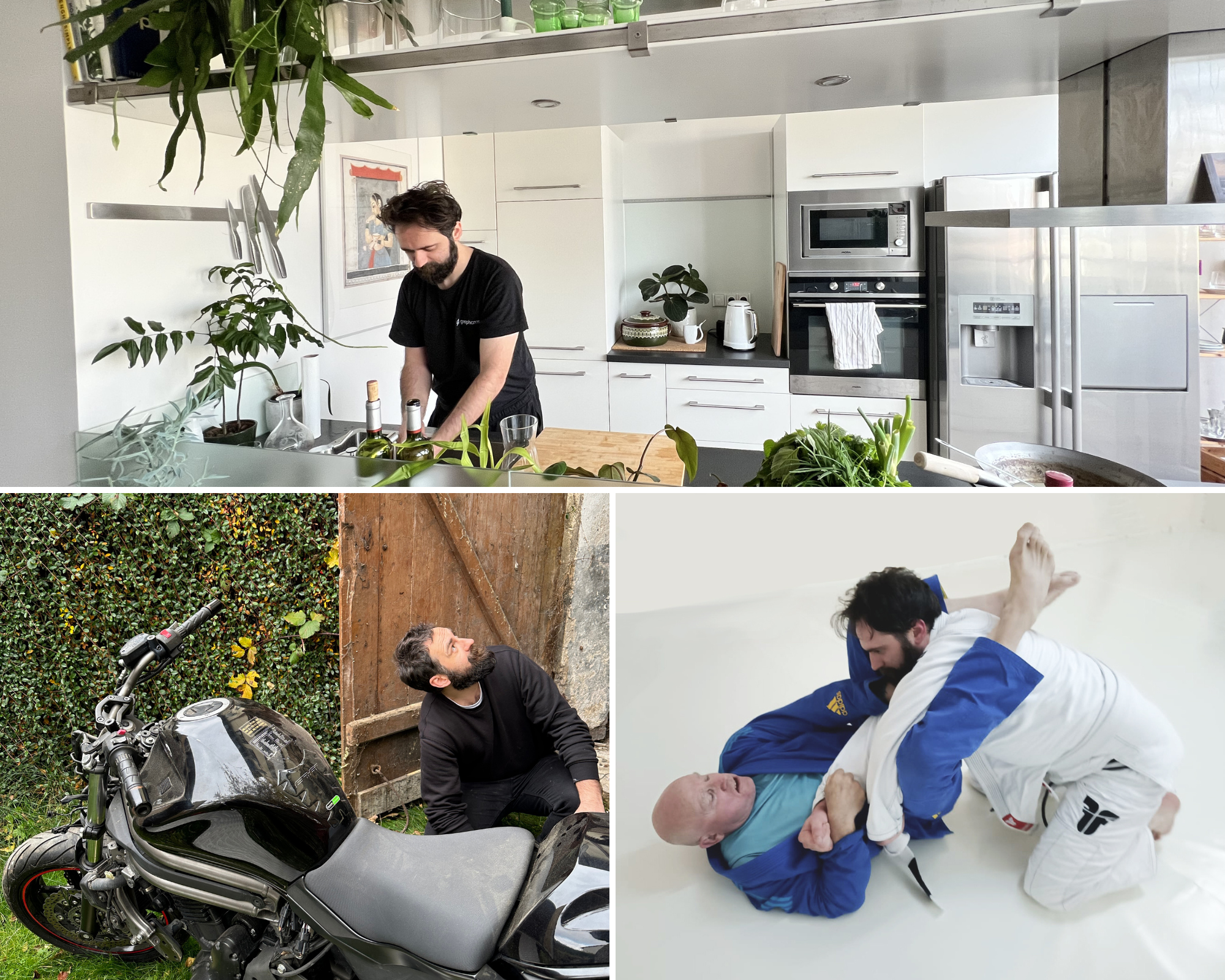
What do you do for fun? How do you unplug?
I got into swimming about three years ago, and as I improved, I started enjoying it more and more. It’s almost meditative now. I try to swim once or twice a week, ideally in the morning.
I also occasionally train Brazilian Jiu-Jitsu, although I haven’t been very consistent and have been a white belt for about four years.
I’m also into cars and motorcycles. I’ve been restoring a motorcycle for the past year and a half, and it’s almost ready for the road. I also drive a ‘97 Fiat Barchetta that I’m gradually fixing up.
Outside of that, I like building small tools and learning new technologies. If I had the space, I’d probably have a full server room at home.
I also read quite a bit, usually a few books at the same time, covering everything from marketing and technical topics to fiction and sci-fi.
Any side projects or rabbit holes recently?
I enjoy cooking, especially anything involving dough—bread, pasta, pastry.
I also run a couple of side projects, including a job board and a keyword monitoring tool that I built during some time off.
What advice can you give someone considering joining the bunny.net fluffle?
Aside from “just do it,” I think curiosity and genuine interest in what we do and our ecosystem are the most important things. I’m a strong believer that interest in and knowledge of the domain outweigh any skill that may or may not be outdated tomorrow.
Join the fluffle
Dino keeps it straightforward: build something solid, understand the people using it, and don’t overpromise what the product can’t deliver. We’re already seeing that take shape across the fluffle, thanks to his approach.
If that way of working sounds like your kind of thing, you’ll fit right in. Hop over to our careers page and take a look at our open roles.
Comments require cookies. to view and post.